Your privacy is important to us
We use cookies that are necessary for the processing of statistical and technical analyses for website usage.
By closing the Cooking Banner, by clicking the “X” symbol or by denying consent, you will continue browsing without profiling or marketing cookies.
By consenting to the usage of profiling and marketing cookies, we will be able to provide advertising messages that correspond to your needs.
We use cookies that are necessary for the processing of statistical and technical analyses for website usage.
Necessary
Necessary cookies help make the website usable by enabling basic functions such as page navigation and access to protected areas of the site. The website cannot function properly without these cookies. Farmina
SESSID: Preserves the user's status on the various pages of the website and allows access to restricted areas. expiration: Session Type: HTTP
farmina_lang: Saves the selected language. expiration: 1 year Type: HTTP
cookie_test: Used to check if the user's browser supports cookies. expiration: 60 minutes Type: HTTP
CookieConsent#: Stores the user's cookie consent status for the current domain. expiration: 1 year Type: HTTP
Statistics
Statistical cookies help website owners understand how visitors interact with websites by collecting and transmitting information anonymously. Google
_gid: Registers a unique ID used to generate statistical data on how the visitor uses the website. expiration: 1 day Type: HTTP
_gat_farminaGlobal: Used by Google Analytics to collect data on the number of times a user has visited the website, as well as data for the first visit and the most recent visit. expiration: a few seconds Type: HTTP
_dc_gtm_UA#: Used by Google Analytics to collect data on the number of times a user has visited the website, as well as data for the first visit and the most recent visit. expiration: a few seconds Type: HTTP
Google Tag Manager
_ga: Registers a unique ID used to generate statistical data on how the visitor uses the website. expiration: 2 years Type: HTTP
Marketing
Marketing cookies are used to track website visitors. Their purpose is to show advertisements that are relevant and engaging for the individual user and therefore of greater value for third-party editors and advertisers.
Facebook
_fbp: Store and track visits across websites. expiration: 3 months Type: HTTP
Google
ads/ga-audiences: Used by Google AdWords to re-engage visitors that are likely to convert to customers based on the visitor's online behavior across websites. expiration: Session Type: Pixel
test_coockie: Used to check if the user's browser supports cookies. expiration: 1 minute Type: HTTP
Google Tag Manager
_gcl_au: Used by Google AdSense to test advertising effectiveness on all websites that use their services. expiration: 3 months Type: HTTP
Genius tips >
Why Does My Cat Scratch Around the Food Bowl After Eating?
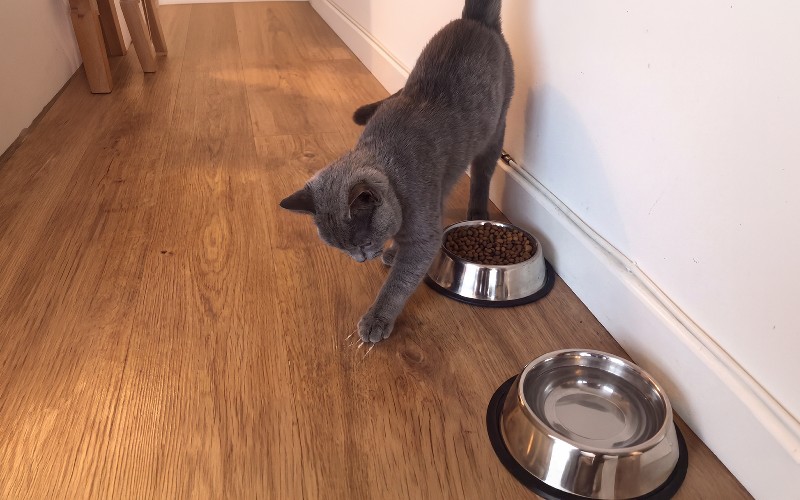
Have you ever noticed your cat scratching the floor around their food bowl after eating? They may paw at the floor, make little digging motions or even scratch around the bowl as if they were trying to cover something. It may look strange, but in most cases, this is completely normal feline behavior. So, what is your cat trying to do?
A behavior rooted in instinct Cats are natural-born hunters, and many of their everyday behaviors are shaped by instincts that helped their wild ancestors survive. One widely accepted explanation for food-bowl scratching is that it relates to covering the scent of leftover food.
Their wild ancestor would have wanted to avoid leaving food behind, since it could attract other animals or reveal their presence to potential competitors or predators, so covering it may have helped keep a food source less noticeable.
Some behaviorists also point to scent glands in a cat's paws, suggesting the scratching could instead be a way of marking territory around a valued resource. Either way, your indoor cat doesn't need to protect their dinner from predators or rivals, but those instincts haven't disappeared.
Why does my cat do it even when there is no food left? You may notice your cat scratching even when the bowl is completely empty. This is also not necessarily a cause for concern: it's the same instinct at work, now simply part of their eating routine regardless of whether there's anything left to cover.
Should I stop my cat from scratching? Usually, there is no need to. If your cat is eating normally, maintaining a healthy body condition and otherwise behaving as usual, scratching around their food bowl is generally nothing to worry about.
However, it’s always important to look at the bigger picture. Eating habits are an important part of your cat's overall wellbeing, and changes in appetite or behavior can sometimes tell you that something has changed.
For example, keep an eye out for persistent changes such as:
suddenly eating much more or much less than usual
repeatedly refusing food
showing difficulty chewing or swallowing
vomiting or other digestive changes
unusual restlessness or distress around mealtimes
significant changes in weight or general behavior
A single unusual meal or behavior does not necessarily mean there is a problem. But persistent or significant changes are worth discussing with your veterinarian. Learning what is normal for your cat can help you notice when something really does change. This is where personalized nutritional support can make a difference.